


The FADER’s longstanding GEN F series profiles the emerging artists you need to know right now.
There’s a lyric on Theodora’s breakout single “KONGOLESE SOUS BBL” that was written specifically for the girls. In the first verse, before the song’s horntastic beat goes batshit crazy, the 22-year-old French-Congolese singer laments the drawbacks of her bodacious physique. “C’est à cause d’mon fiak, il éloigne trop mes g’noux/ Et mes gros seins me font souvent mal au cou,” or, in English, “My ass, it pulls my knees too far apart/ And my big titties often hurt my neck."
“Everybody was like, Oh, your ass is not that big,’” Theodora says of some of the initial reactions she received from the song. “But that was only the boys. The girls was like, ‘Oh, I think I know what she means. Everything was about fun and making fun of my insecurities. Which are the insecurities of most young girls, I think.”
Theodora would know. Growing up as a “weird Black girl” in the countryside of France, she’s been able to turn that trait into a superpower as the country’s brightest young starlet. When we connect over a video call this summer she’s on break in Paris for a few days before she’ll fly to Belgium to play her second of at least 20 European music festivals this year, a life change she still can’t quite believe.

“A year ago I was nobody. And today, I have people saying to me, ‘I’m so fond of your music,’” she says, incredulously while rolling a blunt, her hair out of its usual bimbo bleach-blond wig and laid neatly against her scalp in twists. “I’m like, how do you even understand what I'm saying? It’s not weird, but it’s like, oh damn, it’s crazy.” She takes a beat for emphasis. “Yeah, it's crazy.”
Now that Theodora has become certifiably famous in France, she’s more conscious about wearing her favorite wigs. “I’m doing more natural hair styles with afro texture or something like that, because I know that I'm changing many minds. Many minds of little Black girls,” she tells me. There’s a lot more she has to think about now: When she goes on radio shows and code switches to “intellectual French,” as she puts it; and at press interviews, when she has to decide how she’ll respond to “microaggressive” questions that compare her to the other few French Black women singers.
In the last decade, France has fielded only one dark-skin Black woman superstar: the French-Malian singer Aya Nakamura, who still faces racism to an unconscionable degree. (After Nakamura was announced to be performing at the 2024 Paris Summer Olympics Opening Ceremony, one of France’s far-right groups protested with a racist banner that read: “No way, Aya, this is Paris, not the Bamako market.”) Coming up in the post-Nakamura spotlight, Theodora’s rise is exemplary not because it’s still a rarity, but because she and her music move as if they weren’t fighting a beating current — even if it still wears her down.
I know that I’m changing many minds. Many minds of little Black girls.
“When you’re a Black girl and you are making music in France, you have to, like, fight five times more. Because nobody likes Black girls,” she says soberly, her English roped thickly inside a French accent. “If I didn’t hold my place there, you wouldn’t see me because we are in a racist country.”


A self-professed “bimbo since birth,” Lili-Théodora Mbangayo Mujinga was actually born in Switzerland to a Congolese father whose career as a military medical practitioner moved her and her brother to Greece, Switzerland, France, and Réunion Island off the coast of Madagascar. She was a teenager when they made their final move back to a small town in the countryside of France, and she’d already fostered a hobby of making music at home with her brother. All the years bouncing around had turned her into an increasingly socially avoidant teen.
But she still loved to party. During lockdown, when she could no longer do so, Theodora and her brother, Jeez Suave, made her first-ever project, Neptune, a trappy rap EP that motivated her to begin taking music seriously. By the time she was back spending nights in the club, she was formulating a new sound incorporating pop, R&B, drum and bass, afrobeats, Creole folk music, and bouyon, a genre born from francophone descendants in the Caribbean. This is what’s all over her 2024 record BAD BOY LOVESTORY, whose bouyon-indebted single “KONGOLESE SOUS BBL” first took off like dynamite on TikTok.

If I didn’t hold my place there, you wouldn’t see me because we are in a racist country.

“When you are a diaspora kid in France, we are going out in spaces mixed up [with] everything. In black clubs you have bouyon, you have Afro-Caribbean music,” she says of her music. “I think my music is about the meetup of different words in the same place.” In France, she fronts a wave of French artists pushing the sound of bouyon in her country and beyond (something that has also garnered her pushback).
Theodora’s sexuality, her embrace and shameless flaunting of it, also informs a large part of her music. The aforementioned “KONGOLESE SOUS BBL” is an obvious example. But the staggeringly sticky “Mon Bébé,” is even more shameless and filled with seemingly queer-coded imagery. “Skinny waist, spicy babe, I love your taste/ Boss lady therefore shout my name,” is a rough English translation of a lyric. With her stage outfits, Theodora exclusively works in lingerie, bikinis, corsets, and inventively draped fabrics that cover censor-demanded areas and nothing else.

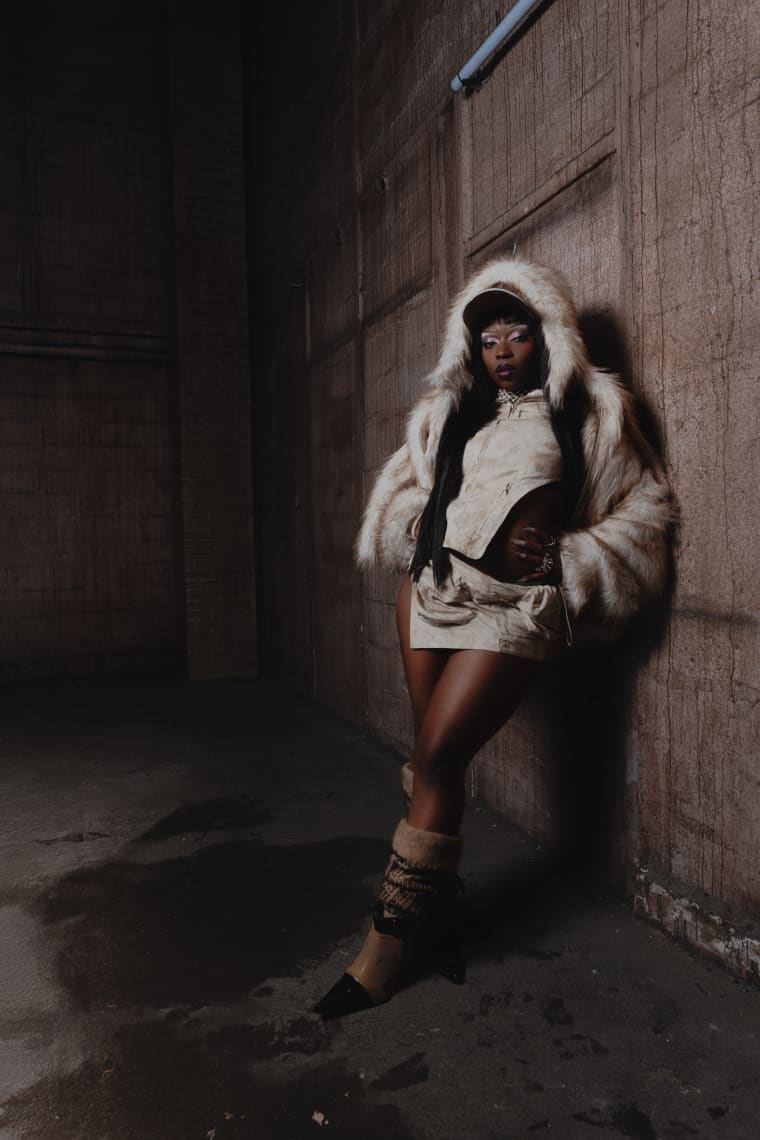
Ultimately, she lives by this French word kiffe, a term that means enjoying the fullness of something. “I'm really about that," she says. "I think I'm gonna be Kiffe, and to enjoy being alive because I think sometime in my life, I didn’t enjoy my life. I really don’t wanna lose this part of my life of becoming a big international star.”
Previously, she had told a reporter that if she wasn’t making music she’d be a politician, though she’s changed her mind about that now. Living in a country that’s perpetually fighting a rising tide of fascism, she's exhausted by the prospect. And besides, “I think I can have more power in music than in politics,” she says. Her 2026 itinerary already whirrs with plans indebted to that goal: touring the world, meeting her idols, going to the Caribbean — “I have to go back to the source of these influences to make music,” she says — more partying, and maybe a visit to the U.S. She pauses, breathless, after listing it all.
“And I'm gonna have sex too, because I'm about that.”
